Arturia Pigments 2 | Tech Spotlight
Let’s take a deeper look at the new Sampler, Granular engine, effects and revamped sequencer within Arturia Pigments 2.

The new Arturia Pigments 2 update introduces a new sound-engine capable of an absolutely huge variety of sounds.
Essentially, it’s a sampler that encompasses everything from a traditional sampler to an advanced granular synthesis engine. The new engine features six slots to load samples into, with several triggering modes to govern how the engine selects which sample to play – you can set it to trigger different samples depending on key, velocity, round-robin mode or random.
The original Arturia Pigments release didn’t grab my attention because at that point in time, it didn’t offer much beyond traditional “analog” style oscillators and a wavetable engine, which are already extensively covered in the plugin industry.
That being said, the modulation system is incredibly workflow-friendly, the fact that you don’t have to cycle through a drop-down list of possible modulation matrix destinations certainly speeds up the pace when sound designing.
Best Features
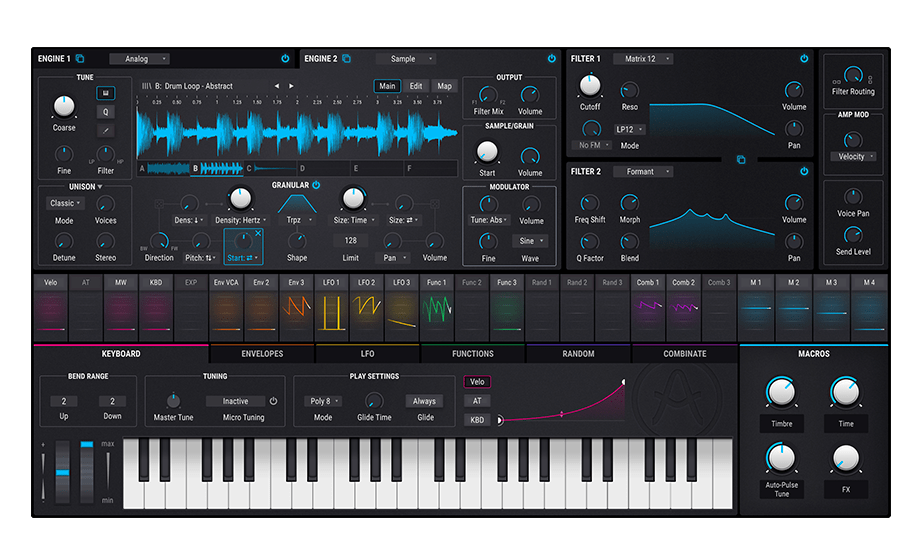
One of the best aspects to Arturia Pigments 2 is the incredibly intuitive visual feedback and ultra-fast workflow capabilities, the visuals make it very easy to pick up on what’s going on in a patch and will undoubtedly make learning the synth easy for newcomers.
Another huge feature is the granular engine, especially considering it’s bundled within such an intuitive plugin – granular synths can often be very complicated for beginners.
The new sequencer is incredible, they’ve added a new non-destructive random mode, which allows you to generate random variations without altering the pattern that you’ve already programmed. This is incredibly handy for creating spontaneous fills and drops and then jumping back to the pre-programmed pattern. Furthermore, you can apply the randomly generated sequence if you like it.
The latest update also adds a new filter mode, the Low-Pass Gate – based on the legendary Buchla LPG. It’s unique in that it can function as both a filter and a vca simultaneously or one or the other. This is great to combine with the binary random generator as it smooths the response of the vca, similarly to an envelope.
The new Tape Echo effect they’ve added knocks it out of the park, it’s based on the highly renowned Delay Tape-201 effect. It features a built-in saturation, free-running or synced delay time, and an added stereo width parameter.
Ideal Users
The new update makes this plugin a lot more appealing in my opinion, the added granular engine makes it a unique option in the plugin market. I’m sure it will be a popular option for movie scoring and cinematics to dance music stuff. It comes with some great sounding presets, that are very thoughtfully categorized – and like I mentioned the interface makes it very easy to dive in and tweak – so it’s a great option for beginners too.
Final Thoughts…
Like I mentioned above, the original Arturia Pigments went a bit under my radar, however, the new additions do make it an incredibly appealing option. It’s currently on a promotion for USD $99 (Around R1450 excl. duties), if you own any other Arturia products – it’s USD $69, and if you own Pigments 1 you can download the new version for free. Thereafter, the retail price is USD $199 (Around R2900 excl. duties)
For more information check out the Arturia website here.
I’ve done a walkthrough video of a bunch of the new features, check that out here:
[youtube_sc url=”https://youtu.be/bv5GqHrV5aY”]


