Ishkur’s guide to electronic music has it all
Check out Ishkur’s guide to electronic music and learn about this electric movement.

When discovering music, we rely on our environment. We start out being influenced by our parents, siblings, and the greater scope of your family. We then go to school and make friends who further shape our musical reference points and so it goes.
All music lovers can look back at crucial moments when they entered the gates of musical heaven, hearing music that makes them weak in the knees.
There are plenty ways to discover new music, but when it comes to understanding how certain genres- especially in the electronic music realm- came to be, Ishkur’s guide is where it’s at!
Enter the electronic music web and explore its myriad genres and sub-genres throughout the ages (well, the mid 1900’s).
music.ishkur.com
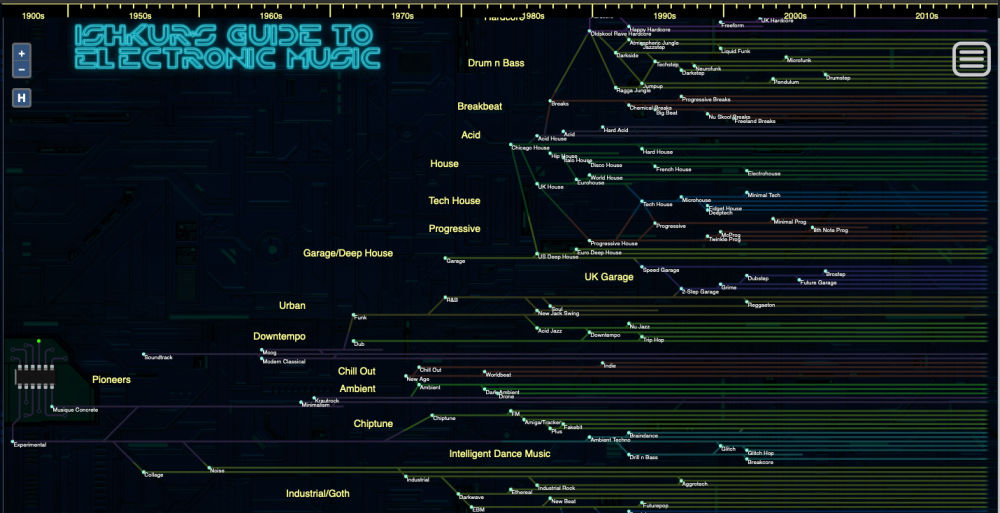
Head on over to Ishkur’s and click an read away. There’s PLENTY to choose from. When clicking on a subgenre, you can listen to related tracks while educating yourself on the genre’s history and defining hardware.
For instance, Acid House emerged in the 1980’s. “It’s a rubbery, squiggly, bubbly, whirrbly, trippy, bouncey, warpy, funky, filthy, screaming, squelching, barking, blistering, scratching, ripping, dripping, driving, liquid-like hypnotic mutant synthline produced by a little silver box called the Roland TB-303 Bassline,” Ishkur explains.
“Acid House was the first genre of electronic music to get a type of party named after it – the Acid House party. It was a hit in Chicago and the Midwest, and it became an even bigger hit in the UK in the summer of 88 (the so-called Second Summer of Love), where vacationing partiers heard it in Ibiza for the first time while also taking ecstasy for the first time (the two compliment each other like a duck’s boner and dragging weeds),” he adds.
This is a SNIPPET of information on one genre- you will have to explore Ishkur’s guide in your own time, which is highly recommended.

